


How to Verify Sanitizer Safety Claims: 7-Step Check
Last Updated: October 23, 2026
Quick Summary
You verify sanitizer safety claims by reading the label for active ingredient and concentration, searching the FDA database by NDC number, and checking recall lists. Then request the test method, organisms tested, contact time and log reduction, plus the safety data sheet, before matching the product to its intended use.
- The CDC notes that 60% to 95% alcohol is effective for disinfection.
- Search the FDA database by NDC number first, then product name, then labeler name.
- A search hit confirms listing, not that the product passed efficacy testing.
- Ask manufacturers for the test method, organisms tested, contact time and log reduction.
- A recalled product can stay on shelves for weeks, so stop using it if listed.
Table of Contents
- What You'll Need Before You Start Checking
- Step 1: Read the Product Label and Active Ingredients
- Step 2: Search the FDA Hand Sanitizer Database for Registration Status
- Step 3: Cross-Check the Hand Sanitizer Recall List
- Step 4: Test Hand Sanitizer Effectiveness Against Viruses
- Step 5: Request the Safety Data Sheet and Test Data
- Step 6: Match the Product to Its Intended Use and Facility Rules
- Step 7: Handle Conflicting or Unverifiable Sanitizer Safety Claims
- Frequently Asked Questions
What You'll Need Before You Start Checking
Verifying sanitizer safety claims starts with a simple truth: the label is a legal document, not marketing copy. This guide walks you through seven steps to check any hand sanitizer. You need the bottle, a browser, and about fifteen minutes.
Keep a few things on hand before you begin:
- The product label, front and back (photograph it so you can zoom in)
- The exact product name and manufacturer from the label
- The NDC number, if one is printed
A common mistake is trusting the front of the bottle. The front sells; the back tells you what's actually inside.
Step 1: Read the Product Label and Active Ingredients
The label answers two questions fast: what's in the product, and how should you use it. According to the FDA guidance on hand sanitizer labels, a compliant label must list the active ingredient, its concentration, warnings, and directions for use. If any of those are missing or vague, treat that as a red flag.
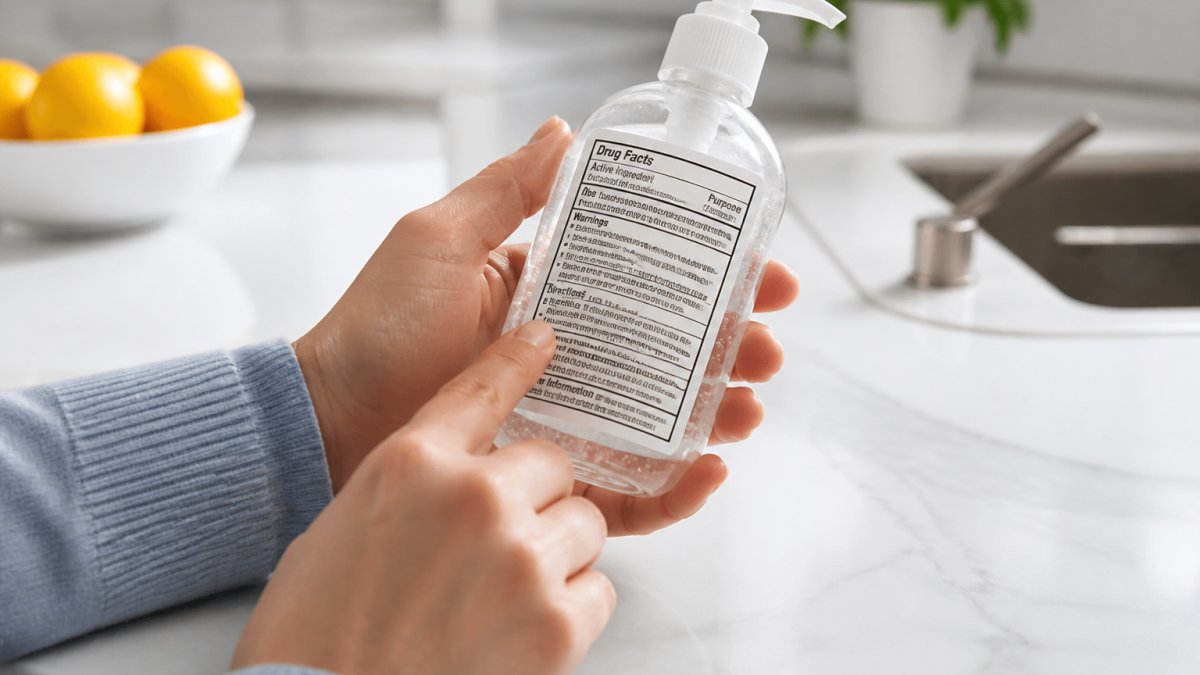
Active Ingredient and Concentration: What the Numbers Mean
The active ingredient is the germ-killing agent; the concentration tells you how much it contains. For alcohol-based sanitizers, the CDC notes that 60% to 95% alcohol is effective for disinfection (the CDC). Below that range, killing power drops. The number matters more than the brand name on the front.
Warning Statements and Directions for Use
Warning statements flag real risks: flammability, eye irritation, or safe use around children. Directions for use give the contact time, how long the product must stay wet to work. A sanitizer that dries in three seconds when the label says thirty isn't doing its job.
Step 2: Search the FDA Hand Sanitizer Database for Registration Status
Registration status tells you whether a product is listed with the FDA and is the fastest way to spot a legitimate manufacturer. The FDA maintains searchable drug establishment registration and drug listing data, and the National Drug Code (NDC) ties a bottle to that data.
Understand the NDC Before You Search
The NDC is a three-segment number, typically printed on the back or side of the label, identifying the labeler (the company responsible for the product), the product, and the package size (the FDA). Read it as three chunks, because the database stores it that way. If the label shows 12345-678-90, the segments are 12345, 678, and 90.
Two practical consequences follow:
- A label with no NDC at all is a warning sign for any product making drug-like claims, because a legitimately marketed hand sanitizer is a drug and should carry one.
- A label whose NDC segments don't match the database entry, same product name but a different labeler segment, for example, suggests a relabeled, imported, or counterfeit bottle.
Run the Search in the Right Order
Search by the most specific identifier first, then widen only if you get nothing:
- NDC number. The cleanest match. Enter the full number and confirm the product name and labeler match the bottle.
- Exact product name. Use the name as printed, including size or variant wording. Generic names like "Hand Sanitizer" return dozens of unrelated listings.
- Labeler or manufacturer name. This catches products sold under a different brand name than the one on the bottle.
Read the Result Like an Inspector
A search hit is not a safety endorsement, it confirms the product is listed, not that it passed efficacy testing. Compare these fields against the label:
- Product name and strength (the active ingredient concentration)
- Labeler name and address
- NDC segments, all three
If the product doesn't appear, that doesn't automatically mean it's fake, some products are cosmetics or cleaners, not drugs. But a hand sanitizer making drug-like claims should show up. A mismatch is a serious warning sign, and a match is only the starting line.
Step 3: Cross-Check the Hand Sanitizer Recall List
A recall notice is the clearest signal that a product failed safety checks. The FDA publishes recall notices and market withdrawals for hand sanitizers, often citing contamination, mislabeling, or unsafe ingredients.
Pay attention to recall reasons. Some involve methanol contamination, which is toxic when absorbed through skin; others involve products labeled as sanitizer that contained no alcohol at all. A recall search takes two minutes and can save you from a real health risk.
Step 4: Test Hand Sanitizer Effectiveness Against Viruses
Effectiveness claims deserve the hardest look, because "kills viruses" is a big promise. What does valid proof of efficacy look like, and how do you tell a regulatory claim from a marketing slogan? Here is the sanitizer-specific method.
Separate Three Kinds of Claims
Not every sentence on a bottle carries the same weight. Sort the claims into three buckets:
- Regulatory claims. Statements the product is permitted to make as a drug, tied to its listed active ingredient and directions for use. These are the claims a regulator can act on.
- Test-supported claims. Specific organism kill claims backed by laboratory data the manufacturer can produce on request.
- Marketing language. Words like "advanced," "clinical strength," or "hospital grade" with no defined meaning and no data behind them. These are not evidence of anything.
A product can be legitimate and still lean on marketing language. Find the test-supported claims and check whether they match how you plan to use the product.
Ask for Four Specifics, Not a Brochure
When you request efficacy data, ask for these four items by name. A manufacturer that has the data can answer quickly; one that doesn't will send glossy material instead.
- The test method. Efficacy testing follows standardized protocols, and the method name tells you what was measured. Ask which protocol was used and whether it was run by an independent lab or in-house.
- The organisms tested. "Kills viruses" is not a result. A real result names the specific organisms, a particular influenza strain or a norovirus surrogate, because efficacy is organism-specific.
- The contact time. The most misread number on any sanitizer label: how long the product must stay wet to achieve the tested kill. A 99.9% kill at 30 seconds is a very different promise than one requiring 60 seconds, and if you rub your hands dry in five seconds, you never reached the tested condition.
- The log reduction. Efficacy results are usually reported as log reductions (a 3-log or 4-log reduction, for example), describing how much of the organism was killed. Ask for the number, not the adjective.
Match the Evidence to Your Use
The same bottle can be well-documented for one use and unproven for another. Check that the organisms tested and the contact time match your setting:
- A product tested against bacteria at a 60-second contact time is not automatically proven against viruses at a 15-second rub.
- A product documented for hands is not automatically validated for hard surfaces, food-contact areas, or high-touch equipment.
- Alcohol-free formulas deserve the same evidence standard as alcohol-based ones, the question is whether the tested conditions match the claim, not which ingredient is listed.
For alcohol-free formulas, the question gets sharper. It's worth reading a deeper breakdown of whether alcohol-free sanitizer is effective against viruses before accepting any label at face value. The short version: the claim should match independent test results, not a marketing slogan.
If a manufacturer can't produce those four specifics, treat the efficacy claim as unverified, not necessarily false, but unproven, and weigh that against the alternatives on the shelf.
When you request efficacy data, ask for these four specifics by name.
| Specific | What to ask | Why it matters |
|---|---|---|
| Test method | Which protocol was used and by whom | Tells you what was measured |
| Organisms tested | The specific organisms named | Efficacy is organism-specific |
| Contact time | How long the product must stay wet | A 30-second kill differs from 60 seconds |
| Log reduction | The number, not the adjective | Describes how much organism was killed |
Step 5: Request the Safety Data Sheet and Test Data
The safety data sheet, or SDS, is a standardized document listing hazards, handling instructions, and first aid measures. Manufacturers must provide it on request, and it's often more honest about limitations than marketing material.
Ask the manufacturer for three things:
- The safety data sheet for the exact product
- Test data showing which microorganisms the product kills
- The name of the lab that ran the tests
Independent lab results carry more weight than in-house testing. If the company sends a glossy brochure instead of a data sheet, that tells you something too.
Step 6: Match the Product to Its Intended Use and Facility Rules
A sanitizer that works fine at home may not meet the rules for a clinic, school, or food service kitchen. Facilities often have their own requirements, from contact time to ingredient restrictions. Match the product to where it will be used.
Two questions decide most of this:
- How long does the protection last between washes? A product built for eight hours of coverage fits a retail shift differently than one needing constant reapplication. We explain the timing in our guide on how long hand sanitizer protects your hands.
- Is it safe for the people using it? Facilities with young children need extra care. Our article on whether non-alcohol hand sanitizer is safe for kids covers what parents and staff should check.
Step 7: Handle Conflicting or Unverifiable Sanitizer Safety Claims
Conflicting claims are common and not always a sign of bad faith. Two products can both be legitimate and still list different contact times or target different germs.
Use this checklist when claims don't line up:
- Does the label name the active ingredient and concentration?
- Does the product appear in the FDA database under the same name?
- Is the product clear of current recall notices?
If a claim still doesn't add up, ask the manufacturer directly. Our FAQ page answers common questions about how our formula works and what backs up our claims. And if you decide to switch to a product with verifiable documentation, you can review Hand Defense sanitizer and check its details against the same checklist.
At Hand Defense, our alcohol-free formula is NDC listed, made in the USA, and designed to protect for up to eight hours in a single use. That's the kind of claim you can check, not just read.
The hardest part of verifying a sanitizer isn't the research. It's deciding to do it at all.
If you want a product that holds up to every step on this list, Hand Defense is built for exactly that.
Frequently Asked Questions
How can you tell if a hand sanitizer is safe to use?
Start with the label: confirm the active ingredient and its concentration, read the warning statements, and check the directions for use. Then look up the product in the FDA hand sanitizer database to confirm registration status, and search the recall list for its brand and NDC number. A product that passes all three checks, lists a US manufacturer with contact information, and provides a safety data sheet on request gives you a documented trail to trust. If any of those pieces is missing, treat the sanitizer safety claims as unverified.
Does an NDC listing mean a hand sanitizer is FDA approved?
No. An NDC listing means the product has been entered in the FDA's drug listing system, not that the agency reviewed and approved it. Hand sanitizers are typically marketed under the FDA's over-the-counter monograph framework, which sets allowed ingredients, concentrations, and labeling rather than issuing product-by-product approvals. So an NDC number is useful for identification and recall lookups, but it is not a seal of approval. Pair it with label review, recall checks, and evidence of testing before you rely on it.
How can you check whether a hand sanitizer has been recalled?
Search the FDA's recall notices and enforcement reports using the brand name, manufacturer, and NDC number from the label. Check the manufacturer's own site for a recall notice, since companies often post updates there first. For workplace or facility use, also check whether your supplier has notified you directly. Set a reminder to recheck every few months, because recalls are issued after products are already on shelves. If a product you own appears on a recall list, stop using it and follow the return or disposal instructions in the notice.
How long does hand sanitizer protection last?
It depends on the formula and how it is used. Alcohol-based sanitizers work on contact while the product is wet on your hands and evaporate quickly, so protection ends once hands are dry and you touch a new surface. Some non-alcohol formulas are marketed with longer-lasting claims, but you should ask the manufacturer for the test data behind any duration claim before relying on it. Reapply after visible soiling, after restroom use, and after touching high-contact surfaces, regardless of what the label promises.
