


Alcohol-Free Hand Sanitizer for Sensitive Skin: 2026 Guide
Table of Contents
- Why Alcohol-Based Sanitizer Irritates Sensitive Skin
- Alcohol-Free vs. Alcohol-Based Hand Sanitizer: What Actually Differs
- Alcohol-Free Hand Sanitizer Ingredients: What to Look For and Avoid
- Is Alcohol-Free Hand Sanitizer Effective? Reading the Claims
- Hand Sanitizer for Eczema and Broken Skin
- How to Choose and Use It Without Drying Out Your Hands
- Conclusion
- Frequently Asked Questions
Last Updated: October 17, 2026
Why Alcohol-Based Sanitizer Irritates Sensitive Skin
Alcohol-based hand sanitizer is the default in most clinics, schools, and handbags. For people with sensitive skin, it is also a reliable source of stinging, redness, and cracking.
The problem is not the germ-killing. It is what the alcohol does to your skin while it works. Ethanol and isopropyl alcohol lift moisture and lipids from the outer layer of skin on contact, and repeated use leaves that layer thinner and less able to recover between applications.
How Alcohol Strips the Skin Barrier
Your natural lipid barrier is the thin film of oils and fats that holds moisture in and keeps irritants out. Alcohol dissolves it. A single application is tolerable for most people. Ten applications a day, five days a week, is a different story: the barrier never gets time to rebuild, and skin dryness, cracking, and irritation follow.
Signs Your Sanitizer Is Causing the Problem
Watch for burning within seconds of application, redness across the backs of the hands, flaking between the fingers, and tightness after the gel dries. If hands crack and bleed, the barrier is already compromised. A common mistake is blaming winter weather for symptoms that track your sanitizer schedule instead.
Alcohol-Free vs. Alcohol-Based Hand Sanitizer: What Actually Differs
The core difference is the active ingredient. Alcohol-based products use ethanol or isopropyl alcohol at high concentrations. Alcohol-free hand sanitizer relies on other antimicrobial agents, most commonly benzalkonium chloride, a quaternary ammonium compound that kills germs without the solvent effect on skin lipids.
Germ Reduction, Drying Speed, and Feel
Alcohol works fast and evaporates quickly, which is why it feels dry almost immediately. Alcohol-free formulas often feel slightly different at first, then absorb without the sting. Both categories can carry strong germ reduction claims, but the label has to back them up.
| Feature | Alcohol-Based | Alcohol-Free (Benzalkonium Chloride) |
|---|---|---|
| Active ingredient | Ethanol or isopropyl alcohol | Benzalkonium chloride 0.1% |
| Skin barrier impact | Strips lipids with repeated use | No alcohol burn |
| Sensitive skin suitability | Often irritating | Generally gentler |
| Drying speed | Very fast | Fast, water-based feel |
| Best for | Occasional use | Frequent daily use |
Alcohol-Free Hand Sanitizer Ingredients: What to Look For and Avoid
Read the ingredient label the way you would a food label, but read it in two parts. The Drug Facts panel tells you what kills germs; the inactive ingredients list tells you whether your skin will tolerate it. For sensitive skin, fewer ingredients is usually better, but "fewer" only helps if you know which ones tend to cause trouble and why.
Start With the Active Ingredient
On an alcohol-free sanitizer, the active is usually benzalkonium chloride at 0.1%, sometimes ethyl alcohol is replaced by other antimicrobials such as hydrogen peroxide in low concentrations or octenidine in some clinical formulas. Each active has a different irritation profile. Benzalkonium chloride is generally gentler than high-concentration ethanol on intact skin, but it is not inert: some people develop contact irritation with repeated use, especially on damaged skin. The percentage matters too, a 0.1% label is the standard drug-facts concentration, and products that list a higher percentage are not automatically more effective or more gentle.
Ingredients to Avoid for Sensitive Skin, and Why
- Fragrance (parfum): the single most common cause of allergic contact dermatitis in cosmetics, per dermatology practice. "Unscented" is not the same as "fragrance-free"; unscented products may contain masking fragrance.
- Dyes (FD&C colors): add nothing to germ reduction and are a known irritant for some people.
- Parabens and sulfates: preservatives and surfactants that can sting on compromised skin; sulfates in particular strip lipids.
- Phthalates: plasticizers that can appear in fragrance blends and are worth avoiding when you are already reactive.
- High-concentration chlorine compounds: found in some wipes and sprays; irritating to sensitive skin and airways.
- Essential oils (tea tree, lavender, citrus): marketed as natural, but they are fragrance allergens and a frequent trigger.
How to Patch Test Without Wasting a Bottle
Apply a small amount to the inner forearm or the back of one hand twice a day for three to four days. Stop if you see redness, itching, or small bumps. A reaction that appears on day three or four is worth noting the ingredient list so you can compare it with the next product. Patch testing at home is not a diagnosis, it is a filter that saves you from switching brands blindly.
The Label-Reading Shortcut
If the inactive list is longer than about ten items and includes fragrance, a dye, and an essential oil, put it back. A short list with a stated active percentage, no fragrance, and a preservative system you have tolerated before is the practical target for sensitive skin.
Is Alcohol-Free Hand Sanitizer Effective? Reading the Claims
Yes, when the formula and the label support it. Effectiveness depends on the active ingredient and concentration, not on whether alcohol appears in the name. Benzalkonium chloride at 0.1% is a recognized antimicrobial active in drug facts labeling. Look for an NDC listing for products marketed as antimicrobial hand sanitizers, since that registration signals the product is documented with the FDA rather than sold as a cosmetic.
Check three things on any label: the active ingredient and percentage, the NDC number, and whether the germ reduction claim is specific. Vague claims like "kills germs" are weaker than stated antimicrobial purposes. If a brand cannot tell you what its active ingredient is, that is your answer.
Hand Sanitizer for Eczema and Broken Skin
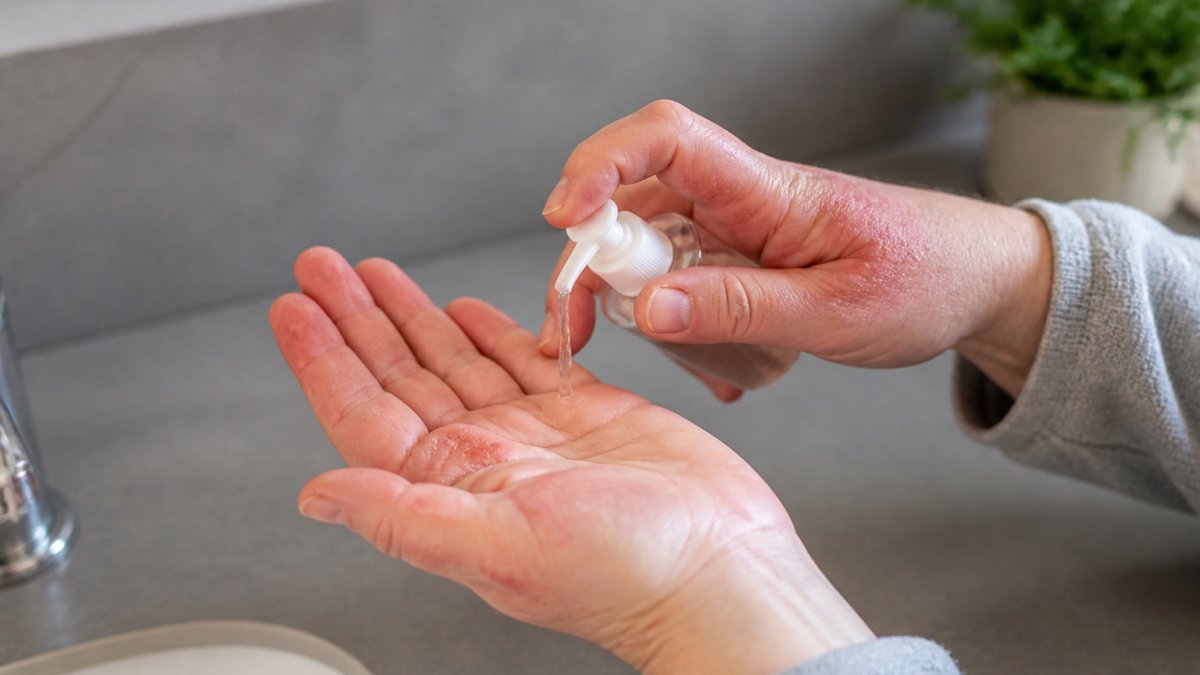
For hand sanitizer for eczema, the rule is simple and uncomfortable: the gentlest formula you can find, applied to intact skin only. Cracked, bleeding hands absorb everything, including ingredients that would not bother healthy skin, because the outer barrier that normally keeps irritants out is physically open. That is why a product that felt fine last month can sting during a flare.
Why Compromised Skin Reacts Differently
Eczema and dermatitis both involve a damaged skin barrier. When the barrier is leaky, water escapes and irritants get in. Anything that strips lipids, alcohol, sulfates, fragrance solvents, makes the next flare more likely and the current one slower to heal. This is also why "alcohol-free" alone is not a guarantee: an alcohol-free formula with fragrance can still trigger a reaction on broken skin.
It helps to separate two patterns. Irritant contact dermatitis is a direct chemical insult, burning, redness, and dryness that track your sanitizer schedule. Allergic contact dermatitis is an immune reaction that can appear 24 to 72 hours after exposure and may worsen with each use. The first improves when you switch products; the second often requires identifying and avoiding a specific ingredient.
Practical Rules for Flare-Prone Hands
- Apply sanitizer to intact skin only; skip cracked or bleeding areas and wash gently with mild soap and water instead.
- Choose fragrance-free, dye-free formulas with a short inactive list.
- Moisturize after every sanitize once the product has dried, a thick cream or ointment, not a scented lotion.
- Keep a separate, gentler product for flare weeks rather than pushing through with your everyday bottle.
- Do not apply sanitizer over an open cut, a fresh scrape, or skin that is actively weeping.
When to Stop Self-Managing
Patch test on the back of one hand for a few days before switching the whole family. If irritation or redness develops, stop use. Persistent irritation beyond a few days, spreading rash, oozing, or pain is a reason to see a healthcare professional. People with diagnosed eczema or psoriasis, and anyone using prescription topicals, should ask their clinician which sanitizer format fits their treatment routine. Sanitizer is also not a substitute for handwashing when hands are visibly soiled or greasy; soap and water come first, and that is especially true during a flare when residue can worsen irritation.
The goal is a short, fragrance-free ingredient list, intact-skin application, and a moisturizing routine that gives the barrier time to rebuild between uses.
How to Choose and Use It Without Drying Out Your Hands
Start with the active ingredient, then the inactive list, then the claims. Use this checklist before you buy:
- Active ingredient and percentage stated on the Drug Facts label
- No fragrance, dyes, parabens, sulfates, or phthalates
- NDC listing for antimicrobial products
- Specific germ reduction claim, not a vague one
- Pump or spray format that covers both hands in one application
Hand Defense is built around exactly this trade-off: an alcohol-free, water-based formula with benzalkonium chloride 0.1% as the active ingredient, no alcohol burn, and a single pump to cover both hands. It is NDC listed and made in the USA, and one 1 oz bottle covers about 150 uses at $19.99. For parents, teachers, and clinical staff sanitizing dozens of times a day, that combination is the reason to switch.

Apply to dry hands, not damp ones. Water dilutes the active ingredient.
Conclusion
The challenge is simple: frequent sanitizing and healthy skin usually pull in opposite directions, and most people accept irritation as the price of germ protection. It does not have to be. Choose by active ingredient, skip the fragrance, and stop treating the burn as normal.
Hand Defense offers an alcohol-free, water-based formula that reduces bacteria that can potentially cause disease, with no alcohol burn and no water needed. It is NDC listed and made in the USA, with about 150 uses per 1 oz bottle. Add it to your cart and give your hands a break.
Frequently Asked Questions
Is alcohol-free hand sanitizer effective at killing germs?
It can be, but effectiveness depends on the active ingredient rather than the absence of alcohol. Alcohol-free formulas typically use benzalkonium chloride, a quaternary ammonium compound that reduces bacteria on skin. Look for an NDC-listed product with a stated active ingredient percentage and directions for use, since those details signal the formula has been registered and reviewed. A product that only says 'kills 99.99% of germs' without naming its active ingredient gives you nothing to verify. Check the Drug Facts label before you trust the claim.
Can alcohol-free hand sanitizer irritate sensitive skin?
Yes. Removing alcohol lowers the sting and dryness risk, but other ingredients can still trigger reactions. Fragrance, artificial dyes, parabens, sulfates, and phthalates are common culprits for people with sensitive skin or eczema. Read the full ingredient label, not just the front of the bottle, and patch test on a small area first. If redness, itching, or cracking develops, stop use. A formula with few inactive ingredients and no added fragrance is the safer starting point for reactive skin.
What ingredients should people with sensitive skin avoid in hand sanitizer?
Watch for added fragrance and artificial dyes, which are frequent causes of contact dermatitis. Parabens, sulfates, and phthalates are also worth avoiding if your skin reacts easily. High-concentration ethanol or isopropyl alcohol formulas can cause dryness and cracking with frequent use. Instead, look for fragrance-free, unscented formulas with a named active ingredient such as benzalkonium chloride 0.1% and a short inactive list. Fewer ingredients means fewer chances for an allergic reaction.
Is alcohol-free hand sanitizer less drying than alcohol-based sanitizer?
Generally, yes. Alcohol evaporates quickly and pulls moisture with it, which is why frequent use leads to dry skin, cracking, and a weakened natural lipid barrier. Alcohol-free formulas skip that step. That does not make every alcohol-free product gentle, though. A formula loaded with fragrance can still irritate. For eczema-prone hands, pair any sanitizer with handwashing at appropriate moments and a moisturizer between uses.